
 Español




Ratchet Tie Down Manufacturers
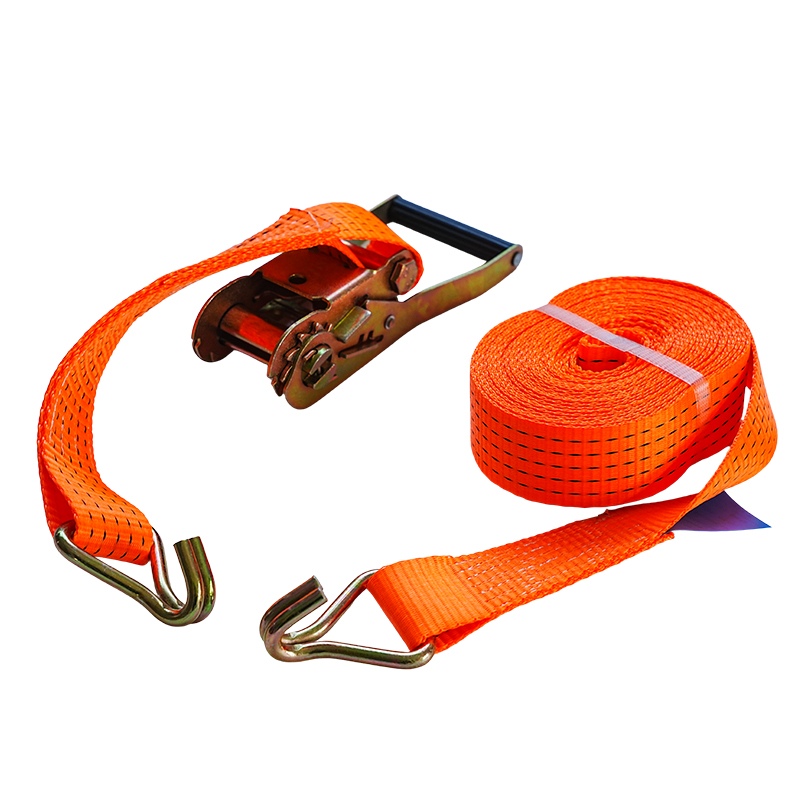
A complete securing system consisting of a high-strength webbing strap integrated with a metal ratchet buckle. This system provides powerful mechanical tensioning for exceptionally tight and secure fastening of heavy, high-value, or irregularly shaped cargo.

Shanghai We Pack Co., Ltd.
Founded in 2019, Shanghai We Pack Co., Ltd. is a subsidiary of Shanghai Mengmao Packaging Technology Co., Ltd. is an integrated packaging company specializing in cargo securing, transport protection, and loading optimization solutions. Ratchet Tie Down Manufacturers and Ratchet Tie Down Factory in China.
With a 10,000 m² facility, 120 employees, dedicated R&D, testing, and quality control teams, and 9 production lines, wepack offers end-to-end capabilities from design and testing to mass production.
Driven by an engineering approach, wepack strictly controls every key stage—from raw materials to finished products—to ensure reliable performance in real transport conditions.
We Pack’s core products include paper edge protectors, container dunnage air bags, and lashing systems. Custom Ratchet Tie Down. Through joint ventures and industrial collaboration, our portfolio has expanded to paper pallets, plastic pallets, slip sheets, carton sealing tapes, bubble wrap, stretch film, strapping, and packaging equipment.We provide one-stop packaging and transport protection solutions tailored to different cargo types and logistics scenarios.
All We Pack products comply with AAR, SGS, TUV, and other international transport test standards. We support OEM / ODM customization, offering product design and free packaging solution planning based on cargo type, loading method, load requirements, budget, and printing needs—helping customers reduce total logistics costs by 15–30% while ensuring transport safety.
Certificate
Certificate of Honor


WHAT WE
HAPPENED
Checkout Our Current
News
Industry knowledge
Shanghai We Pack Co., Ltd. manufactures ratchet tie down assemblies as part of its lashing and cargo securing range: high-strength polyester webbing joined to a mechanical ratchet buckle and terminated with the hook or fitting that matches the anchor point. The systems are built for flatbed trailers, containers, rail wagons, project cargo and bundled industrial goods, where a repeatable high-tension tie is needed rather than a hand-tightened knot.
We Pack is a China-based cargo securing manufacturer with in-house R&D, testing and quality control, and supplies Ratchet Tie Down manufacturer output alongside Dunnage Bag void fillers, Paper Corner Protector profiles and Packing Strap systems, so a complete load securing plan can be sourced from one production base. OEM and ODM work covers webbing width, length, buckle type, end fitting, colour and printed branding.
The Ratchet Tie Down Range We Build
The range is organised around the working point rather than a single stock item. Each assembly is a matched set of webbing, buckle and end fitting, and the components are selected together so the weakest element is never the one that decides the load rating.
- Webbing widths — 25 mm, 35 mm, 50 mm, 75 mm and 100 mm polyester webbing, with buckle and hook sized to the same width.
- Buckle types — standard ratchet buckle, long-handle ratchet for higher pre-tension, and cam buckle for light-duty and low-tension applications.
- End fittings — double J-hook, single J-hook, flat hook, S-hook, chain extension, D-ring and endless loop configurations.
- Lengths — fixed lengths, adjustable two-piece assemblies and custom cut lengths; endless loop versions for encircling bundles and coils.
- Markings and colour — lashing capacity, length, batch reference and customer logo printed on the webbing, with black, orange, blue, red or matched Pantone colours.
Where Ratchet Tie Downs Fit in the Securing Plan
Ratchet tie downs carry the tension that stops a load moving forward, sideways or upward. They work hardest where cargo is heavy, irregular or high-value, and where friction alone cannot be trusted to hold the load through braking, cornering and sea motion.
- Flatbed and lowboy transport — steel coils, plate, beams, pipe bundles and timber, lashed over the top and crosswise to the trailer rail.
- Container and rail stowage — machinery, skids and crated equipment tied back to corner castings or lashing rings.
- Project and breakbulk cargo — precast concrete, stone A-frames, glass racks and oversized fabrications secured as a set rather than a single strap.
- Bundled industrial goods — bar, tube, profiles and palletised loads held as one unit before wrapping or strapping.
In a full securing plan the straps are usually combined with dunnage bags to close voids, corner protectors to stop webbing cutting into edges, and anti-slip paper to raise the friction coefficient between layers. We build these as one supply so the components are dimensioned against each other.
Configuration Matrix
| Configuration element | Options we build | Application fit |
|---|---|---|
| Webbing material | Polyester, low elongation, UV and abrasion treated; nylon where higher stretch is preferred | Polyester for road, rail and sea lashing where tension must hold; nylon for shock-absorbing ties |
| Buckle | Ratchet, long-handle ratchet, cam buckle, zinc-plated or forged steel | Ratchet for heavy loads and high pre-tension; cam buckle for light pallets and quick release |
| End fitting | Double J-hook, single J-hook, flat hook, S-hook, chain extension, D-ring, endless loop | J-hooks for container corner castings and trailer rails; flat hooks for webbing slots and stake pockets; endless loop for encircling |
| Length and adjustability | Fixed, two-piece adjustable, custom cut to drawing | Fixed for repeatable fleet use; adjustable where anchor spacing varies between loads |
| Identification | Printed lashing capacity, length, batch code, standard reference, customer logo | Fleet inspection, distributor branding, traceability in regulated transport |
| Kit scope | Straps supplied alone or assembled with dunnage bags, corner protectors, anti-slip paper and strapping | Single-source securing kits for exporters, logistics providers and equipment integrators |
Critical Specifications at the Working Point
A ratchet tie down is specified by its lashing capacity, not by the number printed on the webbing roll. Web lashing assemblies for road transport are generally defined against EN 12195-2, and North American rail and road practice follows the WSTDA T-1 framework; both separate the lashing capacity (LC) from the breaking strength of the assembly.
- Lashing capacity and break strength — the assembly rating is set by the lowest-rated component, so webbing, buckle and hook are matched as a set.
- Elongation at working load — low-elongation polyester keeps pre-tension through a long journey; higher-elongation webbing absorbs shock but needs re-tensioning.
- Lashing angle and geometry — the angle between strap and deck changes the effective securing force, which is why anchor height and load height are part of the sizing.
- Friction and edge protection — anti-slip layers and corner protectors reduce the number of straps needed and stop webbing being cut on sharp edges.
- Hardware durability — plated or forged buckles and hooks resist corrosion in marine air and repeated yard handling.
Quality Control and Acceptance Testing
Every key stage is controlled from raw webbing and hardware through to the finished assembly. Our own laboratory, testing equipment and third-party institutions such as SGS and TUV support the verification work, and our management system is ISO 9001 certified.
- Incoming inspection of webbing width, weave density, colour and hardware finish before assembly.
- Tensile testing of webbing and proof-load checks on buckles and hooks.
- Ratchet cycle testing to confirm the release mechanism stays operable after repeated use.
- Salt spray assessment on plated hardware for marine and coastal routes.
- Third-party test reports and AAR, SGS and TUV compliance evidence issued with the shipment where the project requires it.
Customization and Integration Support
OEM and ODM work is handled by our own engineering team, which develops from customer drawings or samples and confirms the working point before tooling is set. Printed webbing, custom lengths, matched colours and private-label packaging are all part of the standard offer, with trial quantities starting from 100 pieces and the same lines carrying larger programmes.
Because the securing system rarely stops at the strap, we coordinate the surrounding items: dunnage bags sized to the void, corner protectors matched to the edge radius, anti-slip paper for layer friction, and strapping or tools where the load is bundled rather than lashed. Packaging equipment agents and system integrators use the same supply for consumables that must run reliably through strapping and wrapping lines.
Information We Use to Configure Your Solution
A quotation is only as good as the working point behind it. These are the inputs that change the configuration, and the ones we ask for before proposing a strap set.
| Project input | What it determines |
|---|---|
| Cargo type, weight and dimensions | Webbing width, lashing capacity and the number of assemblies per load |
| Anchor points and lashing angle | End fitting type, strap length and whether a chain extension is needed |
| Transport mode and route | Hardware finish, corrosion protection and the compliance evidence issued |
| Loading method and void size | Whether dunnage bags, corner protectors or anti-slip paper are added to the kit |
| Printing, colour and labelling | Branding artwork, label content and packaging format |
| Order quantity and delivery schedule | Production planning across the nine lines and shipment consolidation |
Documentation, Packaging and Delivery Scope
- Cartons or bales packed to the agreed piece count, with outer labelling for warehouse receipt.
- Batch references recorded against the production run for traceability.
- Test reports, compliance documents and packing lists issued with the shipment.
- Container loading arranged from our Shanghai base, with the factory located close to Shanghai Port and Pudong International Airport.
- Application guidance for the loading team, covering strap routing, tensioning sequence and re-tensioning points.
Frequently Asked Questions
What webbing widths and lashing capacities can We Pack supply?
We build ratchet tie downs on 25 mm, 35 mm, 50 mm, 75 mm and 100 mm polyester webbing, with the buckle and hook sized to match the same width. The lashing capacity is confirmed per configuration against the webbing break strength and the buckle rating, and the printed label carries the LC value, length and batch reference. Give us the load weight, anchor point and lashing angle and we will size the assembly.
Which end fittings suit container corner castings and flatbed rails?
Double J-hooks are the usual choice for container corner castings and trailer rails because the two hooks spread the load and resist twisting. Flat hooks fit webbing slots and stake pockets, chain extensions reach recessed anchors, and endless loop straps are used where the load is encircled rather than hooked.
Can the straps be printed with our brand and cut to our length?
Yes. OEM and ODM work covers printed webbing, custom lengths, matched colours and private-label packaging, developed from your drawing or sample by our engineering team. Trial quantities start from 100 pieces, and the same production lines carry larger repeat programmes.
How are the assemblies tested before shipment?
Webbing tensile, buckle proof load, ratchet cycle and salt spray checks are carried out in our own laboratory, supported by third-party testing through SGS and TUV. Products comply with AAR, SGS, TUV and other international transport test standards, and reports are issued with the shipment where the project requires documented evidence.
Can you supply a complete securing kit rather than straps alone?
We supply the full securing set: ratchet tie downs, dunnage bags for void filling, paper corner protectors for edge protection, anti-slip paper for layer friction, and strapping or packaging tools where the load is bundled. Sourcing them together keeps the components dimensioned against each other and simplifies receipt at the warehouse.
What do you need from us to prepare a quotation?
Cargo type, weight and dimensions, the anchor points available, transport mode and route, the loading method, printing and labelling requirements, order quantity and delivery schedule. With those inputs we confirm the webbing width, buckle type, end fitting, length and kit scope, and return a configuration with the compliance documentation that applies.

PRODUCT
CONTACT INFO
-
 +86-137 7421 9489
-
 +86-021-67558008
-
 [email protected]
-
 No.769 ,23# building, Fengliang Road,Fengcheng town,Fengxian District,Shanghai,China
MOBILE QR CODE

