
 Español

Industry News


What Is a Polyester Woven Strap and How Do You Pick the Right One?
 2026.06.17
 Industry News
Content
- 1 What Is a Polyester Woven Strap and What Makes It Different?
- 2 How Polyester Woven Straps Are Made
- 3 Common Types of Polyester Woven Straps
- 4 Polyester Woven Strap vs. Other Strap Materials: A Direct Comparison
- 5 Industries and Applications That Rely on Woven Polyester Straps
- 6 Key Specifications to Understand When Buying a Polyester Woven Strap
- 7 How to Inspect and Maintain Your Polyester Woven Straps
- 8 Custom Polyester Woven Straps: When Standard Products Aren't Enough
- 9 Frequently Asked Questions About Polyester Woven Straps
What Is a Polyester Woven Strap and What Makes It Different?
A polyester woven strap is a flat, textile-based strap manufactured by interlacing polyester yarns on an industrial loom to create a dense, structured webbing. Unlike extruded plastic strapping or metal banding, a woven polyester strap is flexible, lightweight, and resistant to cutting into soft surfaces — which makes it a practical choice across cargo securing, outdoor gear, fashion accessories, industrial lifting, and medical applications.
The defining characteristic of woven polyester webbing is its construction. The yarns are woven — not knitted, braided, or twisted — which means the interlocking structure distributes tensile load evenly across the full width of the strap. This produces a product that resists elongation under tension, holds its shape after repeated use, and maintains strength even when wet. Compared to nylon webbing, polyester stretches less (typically 10–15% less elongation at break), which is critical in cargo tie-down applications where load shift must be minimized.
Polyester as a raw material also offers excellent UV resistance, low moisture absorption, and good chemical resistance — properties that nylon, for all its strength, doesn't match in outdoor or humid environments. These characteristics explain why woven polyester straps have become the default choice in everything from truck tie-down systems to backpack shoulder harnesses to hospital patient-transfer belts.
How Polyester Woven Straps Are Made
Understanding the manufacturing process helps you evaluate quality and predict performance. Polyester woven straps begin with high-tenacity polyester yarn — a filament yarn engineered specifically for load-bearing applications, with significantly higher tensile strength than the polyester used in clothing or upholstery fabrics. This yarn is wound onto bobbins and fed into a heavy-duty needle loom or shuttle loom, where warp (lengthwise) and weft (crosswise) yarns are interlaced at high speed to form a continuous flat webbing.
The weave density — measured in picks per centimeter (the number of weft passes per unit length) — directly affects the strap's strength, stiffness, and surface texture. Higher pick counts produce a denser, stiffer strap with higher breaking strength. Lower pick counts yield a softer, more flexible webbing suited to applications where comfort or drapeability matters more than raw load capacity.
After weaving, the raw webbing typically undergoes finishing processes depending on its intended use. Heat-setting stabilizes the weave structure and reduces fraying. Coating with polyurethane (PU) or polyvinyl chloride (PVC) adds abrasion resistance and creates a surface that resists oil and chemical contamination. Edge stitching or hot-cut finishing seals the cut ends to prevent unraveling. For color-coded safety applications, the yarn is dyed before weaving so the color runs through the full thickness of the strap rather than sitting on the surface where it can fade or wear off.
Common Types of Polyester Woven Straps
Not all woven polyester straps are built the same way. The type you need depends on the load, the environment, and how the strap will be secured. Here are the main categories:
Flat Polyester Webbing Strap
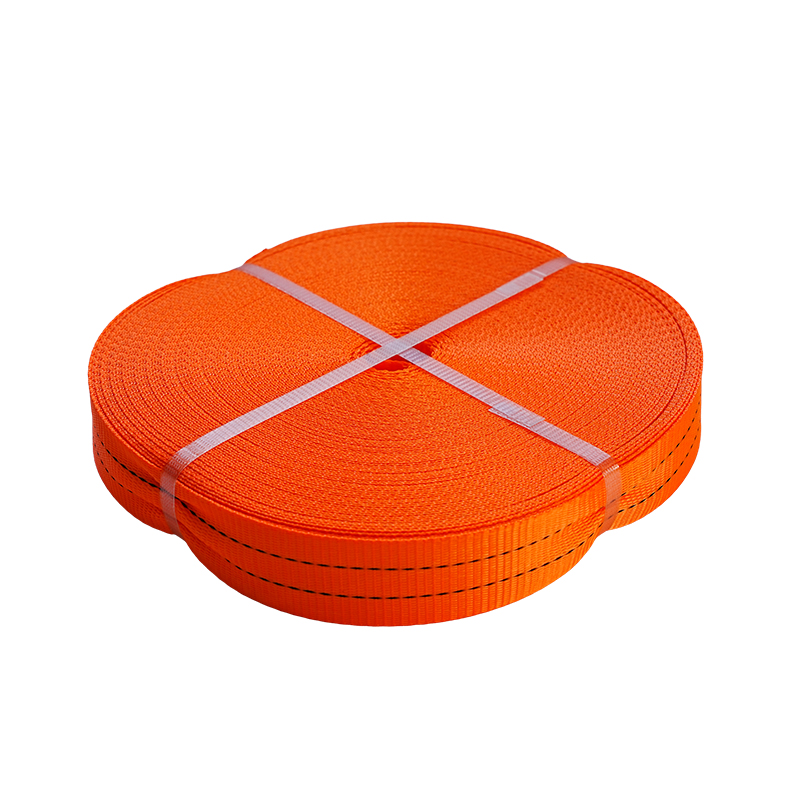
The most basic form — a plain flat strap with no hardware attached. Sold by the roll or cut to length, flat woven polyester webbing is the starting material for most finished strap products. It's used directly in upholstery, luggage making, harness construction, and bulk industrial bundling. Width ranges from as narrow as 6mm up to 150mm or more for heavy lifting slings.
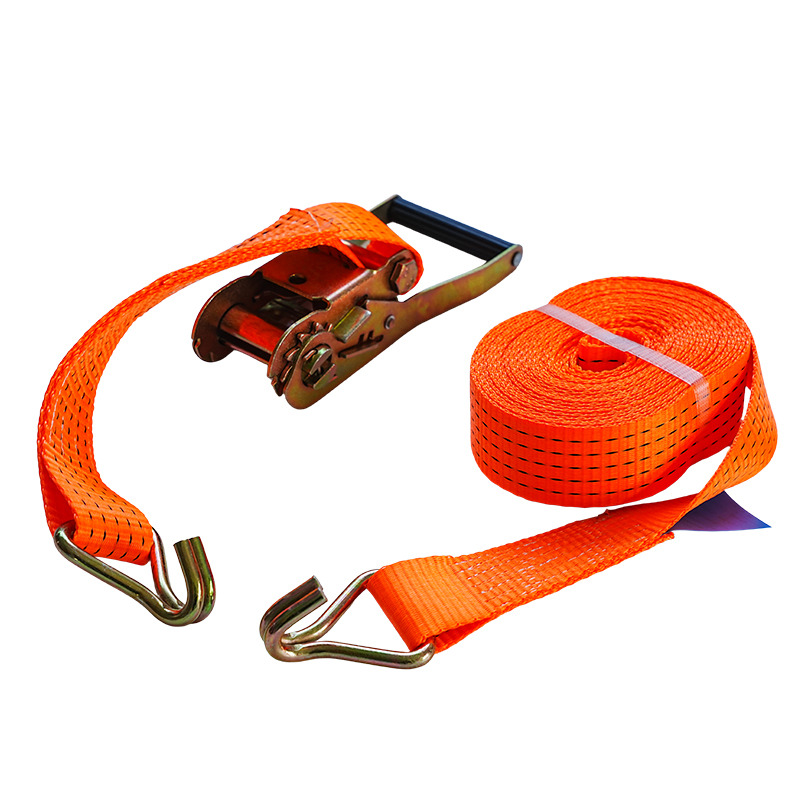
Polyester Ratchet Tie-Down Strap
This is a woven polyester strap fitted with a ratchet tensioning mechanism and end hooks. It's the standard cargo securing tool for trucks, flatbeds, and trailers. The ratchet allows the operator to progressively tighten the strap to a specific tension, and the mechanism locks automatically to prevent release under vibration. Working load limits typically range from 500 kg to 5,000 kg depending on strap width and construction.
Polyester Lashing Strap with Cam Buckle
A lighter-duty alternative to the ratchet strap. The cam buckle uses a spring-loaded friction mechanism to hold tension without the incremental tightening of a ratchet. These are preferred for securing lighter, more fragile cargo — motorcycles, furniture, or sporting equipment — where over-tensioning could cause damage. They're also faster to release, which is useful in applications requiring frequent adjustments.
Polyester Lifting Sling (Flat Web Sling)
Designed for overhead lifting in conjunction with cranes, hoists, and forklifts, polyester flat web slings are manufactured from high-tenacity woven polyester and certified to international lifting standards (EN 1492-1 in Europe, ASME B30.9 in North America). They're color-coded by working load limit and must be inspected before each use and removed from service at the first sign of damage.
Printed and Branded Polyester Woven Straps
In retail, fashion, and promotional contexts, polyester woven straps are custom-printed with logos, patterns, or text using jacquard weaving (where the pattern is built into the weave structure itself) or screen printing. Jacquard-woven labels and straps offer superior durability since the design doesn't sit on the surface but is embedded in the weave — ideal for bag handles, camera straps, and branded lanyards.
Polyester Woven Strap vs. Other Strap Materials: A Direct Comparison
Choosing between polyester, nylon, polypropylene, or steel strapping is a decision that significantly affects performance and cost. The table below compares the key properties:
| Property | Polyester Woven | Nylon Woven | Polypropylene | Steel Strapping |
| Tensile strength | High | High | Medium | Very High |
| Elongation under load | Low (3–7%) | Higher (10–15%) | Medium | Very Low |
| UV resistance | Excellent | Poor | Good | N/A (rusts) |
| Water absorption | Very Low (~0.4%) | High (~4–8%) | Very Low | N/A |
| Surface safety on cargo | Gentle | Gentle | Moderate | Can damage surfaces |
| Cost | Moderate | Moderate–High | Low | Low–Moderate |
| Reusability | High | High | Low–Medium | Single-use |
The takeaway: polyester woven strapping sits in an ideal middle ground — stronger and more dimensionally stable than polypropylene, more UV-stable and moisture-resistant than nylon, and far safer on finished cargo surfaces than steel. For the majority of tie-down, lifting, and securing applications, it's the most well-rounded choice.
Industries and Applications That Rely on Woven Polyester Straps
Woven polyester strapping appears in a remarkably diverse range of industries. What unites all these applications is the need for a strap that is strong, dimensionally stable, lightweight, and gentle on surfaces.
Freight and Cargo Transport
This is the largest single application for polyester cargo straps. Trucking, rail freight, and shipping container loading all require compliant load securing, and polyester ratchet straps are the dominant solution. Regulations such as the European Standard EN 12195-2 and the US Department of Transportation (DOT) tie-down requirements specify minimum working load limits and aggregate working load limits — and polyester webbing straps are specifically engineered to meet these standards. A standard 50mm wide polyester ratchet strap typically has a working load limit of 2,500 kg and a breaking strength exceeding 7,500 kg.
Industrial Lifting and Rigging
Polyester flat web slings are certified lifting accessories used in construction, manufacturing, and warehousing. Their wide, flat profile distributes the load across the full contact area, reducing the risk of point loading that can damage machinery, structural steel, or precision components. They are considerably lighter than chain slings of equivalent capacity, reducing operator fatigue and handling time.
Outdoor and Adventure Gear
Backpacks, climbing harnesses, mountaineering gear, kayak tie-downs, and camping equipment all make heavy use of polyester webbing straps. The combination of strength, low weight, UV stability, and resistance to moisture makes polyester the preferred choice over nylon for outdoor equipment manufacturers. Harness webbing in particular must meet stringent EN 354 and EN 795 standards for fall protection, and polyester webbing consistently performs well in these certifications.
Medical and Rehabilitation Equipment
Patient positioning belts, wheelchair lap belts, transfer slings, and prosthetic limb harnesses all use woven polyester webbing. In medical contexts, the low moisture absorption of polyester is particularly valuable — it prevents bacterial growth and allows the strap to be laundered repeatedly without significant degradation of strength. The softness and smooth surface texture also reduce the risk of skin irritation for patients in long-term contact.
Fashion, Bags, and Accessories
Luggage handles, bag shoulder straps, belt loops, watchbands, and camera straps are all routinely made from woven polyester webbing, often in custom widths, colors, and jacquard-woven patterns. The material holds dye exceptionally well and maintains its appearance over years of use, which is why it's favored by both budget and premium accessory brands. Custom woven polyester straps with brand logos embedded in the weave are a staple of the promotional merchandise industry.
Agriculture and Horticulture
Polyester strapping is used for bundling crops, supporting young trees, securing greenhouse structures, and tying baled materials. Its UV resistance makes it far more durable than natural fiber alternatives like jute or sisal in outdoor agricultural settings, and it doesn't rot or mold when exposed to soil and moisture.
Key Specifications to Understand When Buying a Polyester Woven Strap
Shopping for woven polyester straps without understanding the specifications is a common mistake that leads to either under-buying (unsafe) or over-buying (unnecessary expense). Here are the critical numbers to look for:
- Breaking Strength (BS): The maximum tensile force the strap can withstand before it fails. This is a laboratory measurement and should never be used as the operational limit. Always work within the Working Load Limit instead.
- Working Load Limit (WLL): The maximum load the strap is rated for in normal use. For cargo straps, WLL is typically one-third of the breaking strength. For lifting slings, the safety factor is usually 7:1 (WLL is one-seventh of breaking strength).
- Width: Standard widths for cargo straps are 25mm, 35mm, 50mm, and 75mm. Wider straps distribute load over a larger area and generally have higher WLLs. For lifting slings, widths up to 300mm are common.
- Thickness / Weight per Meter: A heavier webbing (more yarn per unit length) generally indicates higher strength and durability. For industrial applications, look for specifications from the manufacturer that state yarn denier and weave density.
- Elongation at Break: Expressed as a percentage. For cargo securing, lower elongation is better — it means less load shift during transit. Polyester typically shows 3–7% elongation, compared to 10–15% for nylon.
- Coating or Finish: Uncoated webbing is softer and more flexible. PU-coated or PVC-coated straps offer better abrasion and chemical resistance but are stiffer. Choose based on the environment the strap will be used in.
- Compliance Markings: For cargo use, look for EN 12195-2 compliance. For lifting, EN 1492-1 (flat slings) or EN 1492-2 (round slings). In North America, WSTDA (Web Sling and Tie Down Association) standards apply. Compliant straps carry permanently attached labels with WLL, length, and standard reference.
How to Inspect and Maintain Your Polyester Woven Straps
A polyester binding strap that looks fine externally may have suffered internal fiber damage that significantly reduces its strength. Regular, systematic inspection is not optional — it's a safety requirement, and in commercial applications it's typically a legal obligation.
Before Every Use
Run the full length of the strap through your hands, feeling for irregularities as well as looking for them. Check both surfaces and both edges. Look specifically for cuts, abrasion that has worn through more than 10% of the strap's thickness, burns or heat damage (which appears as glazed or hardened fibers), chemical damage (which can cause discoloration or brittleness), knots (which reduce strength by up to 50%), and distortion or twisting of the weave structure.
When to Remove a Strap from Service
Retire the strap immediately — without attempting repair — if you find any of the following:
- Any cut or tear that penetrates the webbing, however small
- Significant abrasion over a localized area (rubbing through multiple yarn layers)
- Acid or alkali exposure — both degrade polyester fiber bonds internally, often without visible external signs
- Missing, illegible, or damaged identification label (for certified lifting or cargo straps)
- Any evidence that the strap was shock-loaded (sudden dynamic loading well above the WLL)
- Damaged, bent, or deformed hardware including hooks, buckles, or ratchet mechanisms
Cleaning and Storage
Clean polyester webbing straps with warm water and a mild detergent. Avoid bleach, solvents, and strong acids or alkalis. Rinse thoroughly and allow to dry naturally away from direct sunlight before storing. Store straps coiled or folded in a cool, dry, dark location away from sharp edges, heat sources, and chemical storage. Never store under tension. For commercial fleets, a dedicated storage rack with labeled hooks for each strap simplifies inspection tracking and prevents straps from being mixed with damaged ones.
Custom Polyester Woven Straps: When Standard Products Aren't Enough
Many applications require straps that don't match off-the-shelf dimensions, colors, or performance profiles. Custom woven polyester straps are available from specialist manufacturers with minimum order quantities that have come down significantly in recent years — in some cases as low as 500 meters for basic webbing.
Custom options typically include: specific widths outside the standard range (for example, 18mm or 45mm), bespoke colors matched to Pantone or RAL references, jacquard-woven logos or text built into the weave structure, custom breaking strengths achieved by adjusting yarn denier and weave density, anti-static finishes for electronics handling applications, and flame-retardant treatments for straps used in proximity to heat sources.
When commissioning custom woven polyester webbing, always request a pre-production sample and have it independently tested for breaking strength and elongation before approving full production. This step is especially critical for safety-critical applications such as fall protection, lifting, or patient handling.
Frequently Asked Questions About Polyester Woven Straps
Can polyester woven straps be used in wet conditions?
Yes — and this is one of polyester's key advantages over nylon. Polyester absorbs less than 0.4% of its weight in water, compared to 4–8% for nylon. This means a polyester strap's strength and dimensions remain virtually unchanged when wet. For marine, agricultural, or outdoor applications where straps will regularly be exposed to rain or immersion, polyester woven straps significantly outperform nylon alternatives.
How long do polyester woven straps last?
Service life depends heavily on frequency of use, load levels, exposure to UV radiation and chemicals, and how well the straps are maintained. For infrequently used cargo straps stored correctly, 5–10 years is a reasonable expectation. For daily-use commercial applications, annual replacement is common practice even without visible damage, because cumulative fatigue loading gradually reduces effective strength. Always follow the manufacturer's recommended service life and retirement guidelines.
Is it safe to tie a knot in a polyester strap to shorten it?
No. Knotting any type of textile strap creates a stress concentration point that can reduce breaking strength by 40–50%. If you need a shorter strap, use the correct length from the outset, or use a strap with an adjustable buckle designed for the purpose. Never modify a certified strap by knotting, cutting, or stitching — doing so voids certification and creates a serious safety hazard.
What is the difference between a polyester strap and polyester strapping?
"Polyester strapping" in the packaging industry usually refers to PET (polyethylene terephthalate) plastic strapping — a stiff, extruded band used to bundle packages on pallets. This is a completely different product from woven polyester webbing strap. PET strapping is rigid, has no textile structure, and is not reusable. When searching for woven textile straps, use the terms "polyester webbing" or "polyester woven strap" to avoid confusion with PET strapping products.
Can I repair a damaged polyester woven strap?
In virtually all safety-critical applications, the answer is no. Once a strap has been damaged — whether by cutting, abrasion, chemical exposure, or shock loading — it must be destroyed and replaced. There is no reliable field repair method for woven webbing that restores original certified strength. Some manufacturers offer repair services for certain types of stitched assemblies (such as sling eyes), but these must be performed in a controlled environment and the repaired sling recertified before returning to service.
Related Products



PRODUCT
CONTACT INFO
-
 +86-137 7421 9489
-
 +86-021-67558008
-
 [email protected]
-
 No.769 ,23# building, Fengliang Road,Fengcheng town,Fengxian District,Shanghai,China
MOBILE QR CODE
Copyright © Shanghai We Pack Co., Ltd. All Rights Reserved.
Cargo Securing Solutions Cargo Transport Protection Solutions

