
 Español

Industry News


Paper Corner & Edge Protectors: Specs, Applications, and Sizing Guide
 2026.04.03
 Industry News
Content
- 1 Why Paper Corner and Edge Protectors Are a Packaging Essential
- 2 How Paper Corner Protectors Are Constructed and Why It Matters
- 3 Paper Edge Protectors: Applications Beyond the Corner
- 4 Industry Applications and Product Categories That Rely on Paper Protection
- 5 Compressive Strength Testing and How to Read the Specifications
- 6 Choosing Between Standard and Custom Sizes for Your Packaging Line
Why Paper Corner and Edge Protectors Are a Packaging Essential
Damage during transit is one of the most persistent and costly problems in product shipping. Crushed corners on furniture, dented edges on appliances, and cracked frames on artwork all share a common cause: inadequate protection at the most structurally vulnerable points of a package — its corners and edges. Paper corner protectors and paper edge protectors address this directly by reinforcing precisely these zones, distributing compressive and impact forces across a broader area before they can reach the product surface.
Unlike foam inserts or bubble wrap, which provide cushioning by absorbing shock through material deformation, paper-based protectors work primarily through structural rigidity. A well-specified paper corner protector resists crushing under the stacking weight of multiple cartons, maintains its geometry under strapping tension, and prevents the pallet wrap or banding from cutting into the product edge. This makes them an active structural component of the packaging system, not merely a passive buffer layer.
From a sustainability perspective, paper protectors offer significant advantages over plastic or foam alternatives. They are manufactured from recycled fiber content, are fully recyclable at end of use, and biodegrade without producing persistent microplastic contamination. For brands communicating environmental responsibility to customers, switching from foam or plastic edge protection to paper-based equivalents is a visible, verifiable improvement in packaging sustainability credentials.
How Paper Corner Protectors Are Constructed and Why It Matters
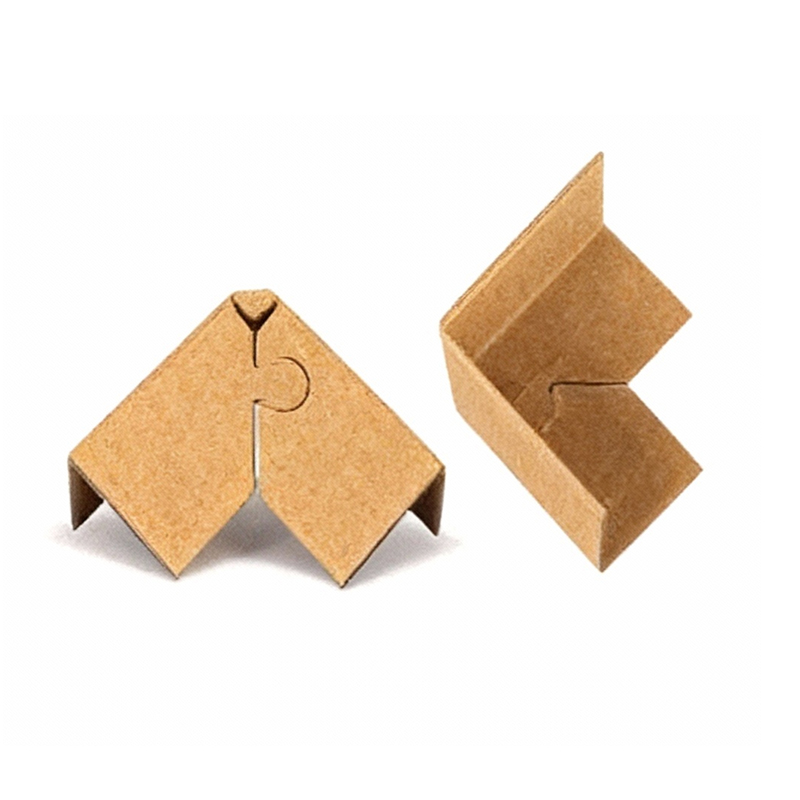
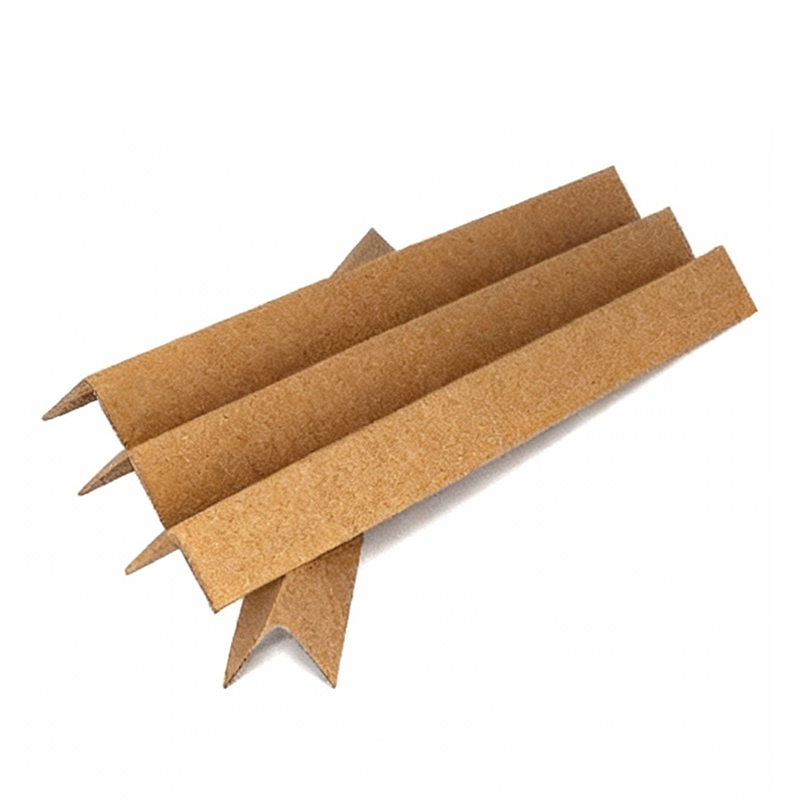
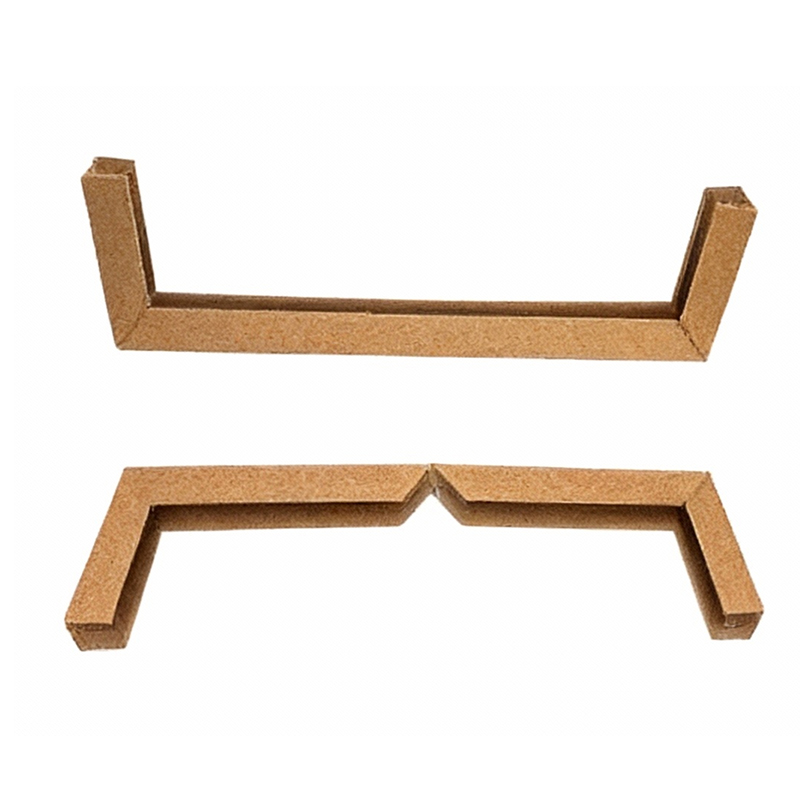
Paper corner protectors are produced by laminating multiple layers of kraft paper under high pressure, then forming the laminated stack into an L-shaped or U-shaped profile. The number of paper plies, the grade of kraft used, and the moisture content of the finished protector all directly influence the compressive strength and rigidity of the final product. Higher ply counts using virgin kraft fiber deliver the greatest load-bearing performance, while recycled fiber constructions balance strength with lower material cost and improved sustainability metrics.
The L-angle is the most common profile for corner protectors. It covers two faces of a product corner simultaneously, providing protection against edge impact from any direction approaching that corner. The dimensions — leg length and wall thickness — are selected based on the size and weight of the product being protected. A small electronics carton might require a 35 × 35 mm leg with 3 mm wall thickness, while a heavy granite countertop or steel appliance panel might require 75 × 75 mm legs at 7–10 mm thickness to withstand pallet stacking loads exceeding 1,000 kg.
Key Dimensional Parameters to Specify
When sourcing paper corner protectors for a specific application, the following parameters must be defined to ensure the protector performs as intended rather than failing under load or fitting incorrectly:
- Leg length (width of each arm): Must be wide enough to spread the contact load across a sufficient area of the product face. Undersized legs concentrate stress and can indent soft surfaces.
- Wall thickness: Directly determines compressive strength. Specify based on the maximum stacking load the pallet configuration will impose on a single corner point.
- Length (cut length of the protector): Should extend at least 80% of the product edge length to provide consistent protection rather than localized coverage at the extreme tip.
- Inside radius: The interior corner radius must accommodate the product's edge profile — a sharp square edge requires a tighter radius than a rounded or chamfered product edge.
Paper Edge Protectors: Applications Beyond the Corner
Paper edge protectors serve a distinct but complementary role to corner protectors. While corner protectors address the point where two edges intersect, edge protectors are applied along the full length of a straight edge — the long sides of a panel, the rim of a glass pane, or the face edge of a stack of boards. This distinction matters because many transit damage events occur along mid-edge zones rather than at corners, particularly when strapping is applied without edge protection.
Polyester or steel strapping applied directly to a carton or wrapped pallet generates highly localized compressive force along the strap path. Without an edge protector beneath the strap at each carton corner and along each edge, the strap cuts into the carton, damages the product inside, and may even sever the outer packaging, compromising the integrity of the entire pallet unit. A paper edge protector distributes this strap load across its full leg width, preventing both product damage and carton failure.
Edge protectors are also extensively used in manufacturing environments as inter-layer separators in stacks of flat panels, glass sheets, and metal blanks. Positioned along the edges of each layer, they prevent direct contact between product surfaces, eliminate edge-on-face chipping, and maintain consistent inter-layer spacing that facilitates safe handling by fork lifts and automated handling systems. In these applications, the paper edge protector functions as both a protective element and a stacking spacer.
Industry Applications and Product Categories That Rely on Paper Protection
Paper corner protectors and paper edge protectors are deployed across an exceptionally wide range of industries, reflecting how universally applicable the problem of edge and corner damage is during shipping and storage. Understanding where these products are standard practice helps procurement teams benchmark their own packaging specifications against industry norms.
| Industry | Typical Products Protected | Primary Protection Need |
|---|---|---|
| Furniture | Flat-pack panels, tabletops, cabinet doors | Corner crush and edge denting during stacking |
| Glass and Glazing | Window panes, mirrors, display glass | Edge chipping from direct contact and strap pressure |
| Building Materials | Drywall, MDF boards, stone slabs | Face and edge protection under heavy stacking loads |
| Appliances | Refrigerators, washing machines, ovens | Panel denting from strapping and impact during handling |
| Printing and Publishing | Book stacks, paper reams, printed cartons | Edge compression and corner collapse in palletized loads |
| Electronics | TV screens, monitors, server equipment | Corner and screen-edge impact protection |
Compressive Strength Testing and How to Read the Specifications
Paper corner protectors and paper edge protectors are typically rated by their edge crush resistance, expressed in kilonewtons per meter (kN/m) or as a maximum compressive load in kilograms or Newtons for a standard test sample length. These figures are generated under controlled laboratory conditions using standardized compression testing equipment, and understanding what they represent — and their limitations — is essential for correct specification.
The rated crush strength reflects performance on a dry sample at standard temperature and humidity (typically 23°C and 50% relative humidity). Real-world performance can deviate significantly from this figure when the protector is exposed to moisture during transit — a common occurrence in refrigerated transport, outdoor handling, or humid warehouse storage. Paper protectors lose a substantial portion of their compressive strength when wet, which must be factored into specifications for cold chain or outdoor shipping applications. In these environments, moisture-resistant coated paper protectors or hybrid paper-plastic constructions should be evaluated against standard kraft alternatives.
When evaluating supplier specifications, request test data that includes sample dimensions, conditioning protocol, and testing standard (such as TAPPI T811 or equivalent). Specifications that state only a single load figure without these parameters cannot be reliably compared across suppliers and may not reflect actual in-service performance.
Choosing Between Standard and Custom Sizes for Your Packaging Line
Standard-size paper corner protectors and paper edge protectors cover the most common product dimensions and are available ex-stock from most packaging distributors, making them the fastest and lowest-cost option for general shipping applications. Standard leg widths typically range from 25 mm to 100 mm, wall thicknesses from 2 mm to 10 mm, and cut lengths from 50 mm to 2,000 mm or in continuous roll format that can be cut to length on the line.
Custom sizing becomes necessary when product dimensions fall outside standard ranges, when the production line requires a specific cut length for automated applicator equipment, or when brand identity requirements dictate printed protectors. Custom-printed paper edge protectors — carrying the supplier's branding or handling instructions — are increasingly common in consumer electronics and premium furniture packaging, where the protector is visible to the end customer during unboxing.
- For low-volume or varied SKU operations: Standard stock sizes with manual application offer the lowest entry cost and maximum flexibility without minimum order commitments.
- For high-volume uniform product lines: Custom-cut lengths matched to the product dimension reduce material waste and eliminate on-line cutting steps, improving throughput and consistency.
- For automated packaging lines: Specify protectors in roll or magazine format compatible with the applicator equipment, and confirm that the paper grade and wall thickness are within the applicator's handling specification.
- For cold chain or high-humidity environments: Request moisture-resistant treated paper grades and verify wet compressive strength data before committing to a specification for refrigerated or outdoor shipping applications.
Whether the application calls for a simple stock paper corner protector applied manually at a packing bench or a precision-cut paper edge protector fed through an automated strapping system, matching the product specification to the operational reality of the packaging line is the factor that separates effective damage prevention from packaging that looks adequate on paper but fails in practice.
Related Products


PRODUCT
CONTACT INFO
-
 +86-137 7421 9489
-
 +86-021-67558008
-
 [email protected]
-
 No.769 ,23# building, Fengliang Road,Fengcheng town,Fengxian District,Shanghai,China
MOBILE QR CODE
Copyright © Shanghai We Pack Co., Ltd. All Rights Reserved.
Cargo Securing Solutions Cargo Transport Protection Solutions

