
 Español

Home / News / Industry News / Stretch Wrap Rolls: How to Pick the Right One and Get the Most Out of It
Industry News


Stretch Wrap Rolls: How to Pick the Right One and Get the Most Out of It
 2026.05.21
 Industry News
Stretch wrap rolls are one of those consumables that get ordered on autopilot until something goes wrong — a load shifts in transit, film tears mid-wrap, or the cost per pallet suddenly looks hard to justify. The reality is that stretch film is a more technical product than it appears, and matching the right roll specification to your actual application makes a measurable difference in load security, material consumption, and total cost. This guide covers what you need to know to make a good decision, whether you're wrapping a few pallets a day by hand or running a high-volume automated line.
Content
- 1 What Stretch Wrap Film Actually Does
- 2 Types of Stretch Wrap Rolls
- 3 Understanding Gauge, Width, and Roll Length
- 4 Matching the Right Stretch Film to Your Load Type
- 5 Hand Dispensers and Application Technique
- 6 Calculating Film Consumption and Cost Per Pallet
- 7 Specialty Stretch Wrap Roll Formats
- 8 Sustainability and Recycling Considerations
- 9 Common Problems with Stretch Wrap Rolls and How to Fix Them
What Stretch Wrap Film Actually Does
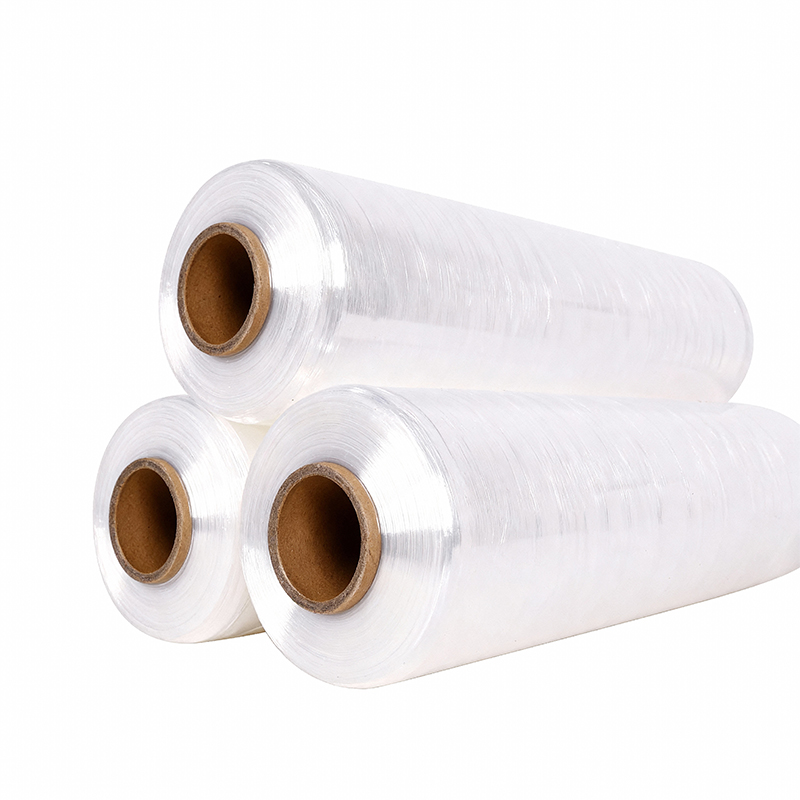
A stretch wrap roll is a roll of highly elastic plastic film — almost always linear low-density polyethylene (LLDPE) — designed to be stretched around a load and held in tension. The film doesn't adhesively bond to itself in the conventional sense; instead, it clings through the elastic tension it maintains after being stretched. This self-cling property is what keeps the wrap in place around a pallet or bundled load without requiring heat, glue, or fasteners.
The stretching process is key to understanding why film specification matters. When stretch film is elongated — typically 100% to 300% of its original length depending on the film grade and application method — the molecular chains in the LLDPE align, significantly increasing the film's tensile strength and load-holding force. A film that is applied without adequate pre-stretch wastes material, delivers less holding force, and costs more per pallet than a properly stretched application of the same film.
Stretch wrapping also protects loads from dust, moisture, and handling damage during storage and transit. For pallets moving through outdoor or cold-chain environments, the moisture barrier function is as important as the load containment function, and film selection needs to account for both.
Types of Stretch Wrap Rolls
The stretch film market divides primarily into hand application and machine application formats, with several sub-categories within each. Understanding the differences is the starting point for any sourcing decision.
Hand Stretch Wrap Rolls
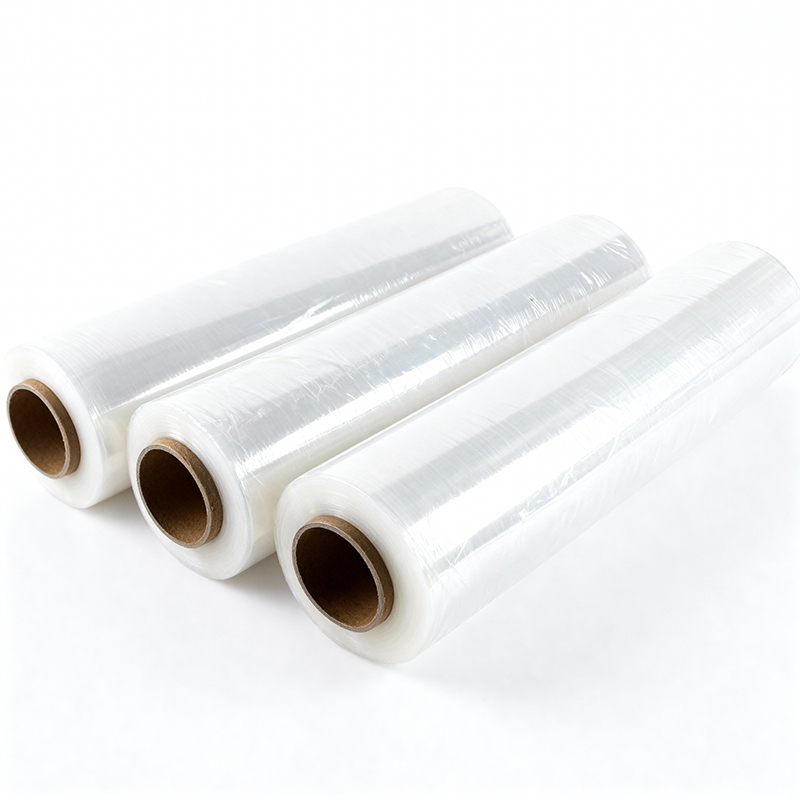
Hand stretch wrap rolls are designed to be applied manually, either directly by hand or with a handheld dispenser. They are typically 12 to 18 inches (300–450mm) wide, with core sizes of 1.5 or 3 inches, and are wound to roll lengths of 1,000 to 1,500 feet (300–450 meters) per roll. The film gauge for hand application usually runs from 37 to 80 gauge (9–20 microns), with 47 to 60 gauge being the most common range for standard pallet wrapping.
Hand stretch film is the right choice for operations wrapping fewer than 15 to 20 pallets per day, for irregularly shaped loads that require manual wrapping judgment, and for applications where a stretch wrap machine is not practical due to space or budget constraints. The tradeoff is that hand application is physically demanding and difficult to standardize — wrap tension, overlap percentage, and number of revolutions vary between operators, which creates inconsistent load containment quality.
Machine Stretch Film Rolls
Machine stretch film rolls are designed for use with rotary arm or turntable stretch wrap machines. They are wider — typically 20 inches (500mm) — wound on 3-inch cores, and come in significantly longer roll lengths, commonly 5,000 to 9,000 feet (1,500–2,700 meters) per roll. The film is formulated to be pre-stretched by the machine's powered rollers before it contacts the load, which is how machine application achieves much higher pre-stretch ratios (200–300%) than hand application can realistically deliver.
Machine film gauges vary from 37 to 120 gauge (9–30 microns), but the relationship between gauge and performance is less direct than with hand film because the machine pre-stretch mechanism does the work. A 37-gauge machine film applied at 250% pre-stretch delivers better load containment and lower cost per pallet than a 60-gauge hand film applied manually — which is a key part of the economic case for investing in stretch wrapping equipment once volumes justify it.
Blown vs. Cast Stretch Film
Within both hand and machine categories, stretch film is produced by one of two manufacturing processes: blown extrusion or cast extrusion. The choice between them affects film properties in ways that matter for specific applications.
Cast stretch film — the dominant product in most markets — is produced by extruding molten polymer through a flat die onto a chilled roller. This produces a film that is clear, quiet to unwind, and consistent in gauge. Cast film is easier to apply and well-suited to most standard pallet wrapping applications. Blown stretch film is produced by extruding a tube of polymer upward and expanding it with air pressure. The resulting film has a higher memory (it returns more strongly to its original length after stretching), is tougher under puncture and tear stress, and provides better load retention for irregular or sharp-edged loads. Blown film is hazier, noisier to unwind, and typically more expensive per roll — but for demanding applications it outperforms cast film on load security.
Understanding Gauge, Width, and Roll Length
Three specifications dominate stretch wrap roll selection: gauge (film thickness), width, and roll length. Each affects performance and cost in distinct ways.
| Specification | Typical Range | Primary Impact |
| Gauge (film thickness) | 37 – 120 gauge (9–30 microns) | Puncture resistance, load containment force |
| Width | 12–20 inches (300–500mm) | Wrapping speed, number of passes required |
| Roll length | 500–9,000 feet (150–2,700m) | Roll change frequency, labor cost per pallet |
| Core size | 1.5 inch or 3 inch | Compatibility with dispenser or machine |
| Pre-stretch ratio | 0% (hand) to 300% (machine) | Film consumption per pallet, holding force |
Gauge is the specification most commonly used to compare rolls, but it is also the most frequently misapplied. A thicker gauge is not always better — in machine applications with high pre-stretch, a thinner film properly tensioned outperforms a thicker film applied without pre-stretch. The right question is not "what gauge?" but "what holding force is required, and what application method will achieve it?"
Width determines how many horizontal passes are required to wrap a standard pallet. An 18-inch (450mm) wide film requires more revolutions to cover a 48-inch tall pallet than a 20-inch film does, which increases wrap time and potentially film consumption depending on overlap percentage. For high-volume pallet operations, the difference in wrapping speed between a 12-inch and a 20-inch roll is operationally significant.
Matching the Right Stretch Film to Your Load Type
Load characteristics — weight, shape, stability, and surface texture — should drive film selection as much as application method does. Using the same stretch wrap roll for every load type in a mixed operation is a common source of both over-specification (wasting money on heavy film for light loads) and under-specification (light film failing on demanding loads).
Light and Stable Loads
Pallets of boxed goods, shrink-wrapped multipacks, or other stable rectangular loads with smooth surfaces can be effectively secured with standard 37 to 47 gauge cast stretch film. These loads don't present puncture risk, don't shift significantly during wrapping, and don't require the high memory properties of blown film. Standard cast hand film or entry-level machine film is the cost-effective choice here.
Heavy or High-Stack Loads
Pallets carrying dense goods — drums, bottles, metal components, bagged materials — that are stacked to full pallet height or above require higher containment force. For hand application, moving to a 60 to 80 gauge film and increasing the number of base wraps provides the additional security needed. For machine application, a higher pre-stretch setting combined with a 47 to 60 gauge film typically achieves better results than simply using a thicker film at lower stretch.
Irregular or Sharp-Edged Loads
Loads with protruding edges, sharp corners, or irregular profiles — machinery parts, building materials, structural steel profiles — are where blown stretch film earns its premium price. The higher puncture and tear resistance of blown film prevents the failure mode most common with these loads: a corner catch that propagates into a full wrap failure during transit. Corner boards used in conjunction with stretch film add further protection and reduce the gauge requirement for film used on palletized sharp-edged goods.
Cold Storage and Outdoor Loads
Loads destined for cold storage or outdoor staging require film that maintains its elastic properties at low temperatures. Standard LLDPE cast stretch film performs adequately down to approximately 0°C, but for freezer storage applications (-18°C and below), a low-temperature formulated stretch film should be specified. These films use modified polymer blends that remain flexible at sub-zero temperatures rather than becoming brittle — a failure mode that can result in complete wrap loss in cold storage environments.
Hand Dispensers and Application Technique
Manual application of a stretch wrap roll without a dispenser — holding the roll directly and walking around the pallet — is physically demanding, inconsistent, and wastes film. A basic hand dispenser with a braking mechanism costs very little and immediately improves wrap quality and reduces operator fatigue. For operations wrapping more than five pallets per shift, a dispenser is not optional equipment; it is a basic ergonomic requirement.
Pre-stretch hand dispensers take this further by incorporating a mechanical gear system that pre-stretches the film as it unwinds — typically achieving 50% to 100% pre-stretch without power. This halves the amount of film consumed per pallet compared to direct hand application, pays back the dispenser cost within a few hundred rolls, and significantly reduces operator effort. The film savings alone justify the upgrade for any operation wrapping more than 10 pallets per day.
Correct wrapping technique also matters. The standard approach for a stable rectangular pallet involves: starting with two to three base wraps at the pallet foot to anchor the film to the pallet base, spiraling upward with 50% overlap per pass, finishing with two to three top wraps, and bringing the film back down over the top edge to lock the top layer. Skipping the base wraps or reducing overlap below 30% to 40% are the two most common technique errors that result in load shifting in transit.
Calculating Film Consumption and Cost Per Pallet
Comparing stretch wrap rolls purely on price per roll or price per kilogram is unreliable because roll length, gauge, and pre-stretch ratio all interact to determine the actual cost of wrapping one pallet. The relevant metric is cost per pallet wrapped, which requires knowing film consumption per pallet.
A rough benchmark for a standard 40 × 48 inch pallet wrapped to 60 inches height with hand film and no pre-stretch is approximately 200 to 300 grams of film per pallet. With a pre-stretch dispenser achieving 100% pre-stretch, the same containment force is achieved with approximately 100 to 150 grams. With a machine at 250% pre-stretch, consumption drops to 60 to 100 grams per pallet. The film cost difference between these three scenarios, across 50 pallets per day over a year, is substantial — often several thousand dollars in film savings alone, excluding the labor time reduction from faster machine wrapping.
When evaluating a switch to a different film specification or application method, tracking actual grams of film used per pallet — rather than rolls used per week — gives an accurate basis for comparison and makes the economics of any change transparent.
Specialty Stretch Wrap Roll Formats
Beyond standard clear pallet wrap, several specialty formats address specific operational requirements that standard film cannot meet.
- Colored stretch wrap rolls: Available in black, blue, red, green, and other colors for load identification, security screening prevention, or zone/product type color-coding in warehouse operations. Black stretch film is also used where UV protection of the wrapped load is required during outdoor storage.
- Printed stretch film: Custom-printed rolls carrying security patterns, brand logos, or handling instructions. The print is applied to the film during manufacturing and cannot be removed without visibly damaging the wrap — providing a tamper-evidence function for high-value shipments.
- Anti-static stretch film: Formulated for wrapping loads containing electronics or other static-sensitive components. Standard LLDPE stretch film generates static charge during unwinding and application; anti-static formulations dissipate this charge rather than building it up on the wrapped load.
- Vented stretch film: Perforated or netted film formats that allow airflow through the wrapped pallet — used for fresh produce, horticultural goods, and other loads that require ventilation to prevent moisture buildup and condensation during storage or transit.
- Bundling stretch film rolls: Narrow-width rolls — typically 2 to 6 inches wide — used for bundling individual items or small groups rather than full pallets. Common applications include bundling pipe, lumber, profile sections, and multi-packs where a full pallet wrap would be impractical or wasteful.
Sustainability and Recycling Considerations
Stretch wrap film is a significant contributor to plastic waste in distribution and logistics operations. LLDPE (resin code #4) is technically recyclable, but it is not accepted in curbside programs — it must be returned to store drop-off collection points or processed through specialist film recycling streams. For operations generating large volumes of used stretch film, working with a waste management provider that handles film recycling rather than sending it to landfill is increasingly both a regulatory expectation and a customer requirement in B2B supply chains.
Reducing film consumption through correct pre-stretch application is the highest-impact sustainability action available within the standard stretch wrap format — using 40% less film per pallet through pre-stretch is more impactful than switching to a partially recycled content film while continuing to over-wrap. Recycled-content stretch films — typically incorporating 30% to 50% post-consumer recycled LLDPE — are available and perform comparably to virgin resin films for standard applications, though they may show slightly reduced clarity and consistency in gauge.
Biodegradable stretch film alternatives exist but are not yet mainstream — they typically involve compromises in stretch performance, cling, and cost that make them impractical for high-volume pallet wrapping. The more practical near-term path for most operations is reducing consumption through pre-stretch optimization and ensuring used film enters a proper recycling stream rather than general waste.
Common Problems with Stretch Wrap Rolls and How to Fix Them
Most stretch film application problems trace back to a small number of root causes. Identifying the actual cause rather than simply switching to a heavier gauge film — the default response in most operations — usually resolves the issue more cost-effectively.
| Problem | Likely Cause | Recommended Fix |
| Film tears during application | Over-stretching, sharp load edge, or cold film | Reduce stretch ratio; use corner boards; store film at room temperature |
| Load shifting in transit | Insufficient base wraps or too little overlap | Add base wraps; increase overlap to 50%; increase film tension |
| Film not clinging to itself | Film applied with insufficient tension or wrong side out | Apply with cling side facing load; increase application tension |
| Excessive film consumption per pallet | No pre-stretch; excessive overlap; over-specified gauge | Introduce pre-stretch dispenser; audit wrap program; downgauge trial |
| Film unwinds unevenly from roll | Roll stored on its side, core deformation, or gauge inconsistency | Store rolls upright on core; check for damage; review supplier quality |
Related Products



PRODUCT
CONTACT INFO
-
 +86-137 7421 9489
-
 +86-021-67558008
-
 [email protected]
-
 No.769 ,23# building, Fengliang Road,Fengcheng town,Fengxian District,Shanghai,China
MOBILE QR CODE
Copyright © Shanghai We Pack Co., Ltd. All Rights Reserved.
Cargo Securing Solutions Cargo Transport Protection Solutions

