
 Español



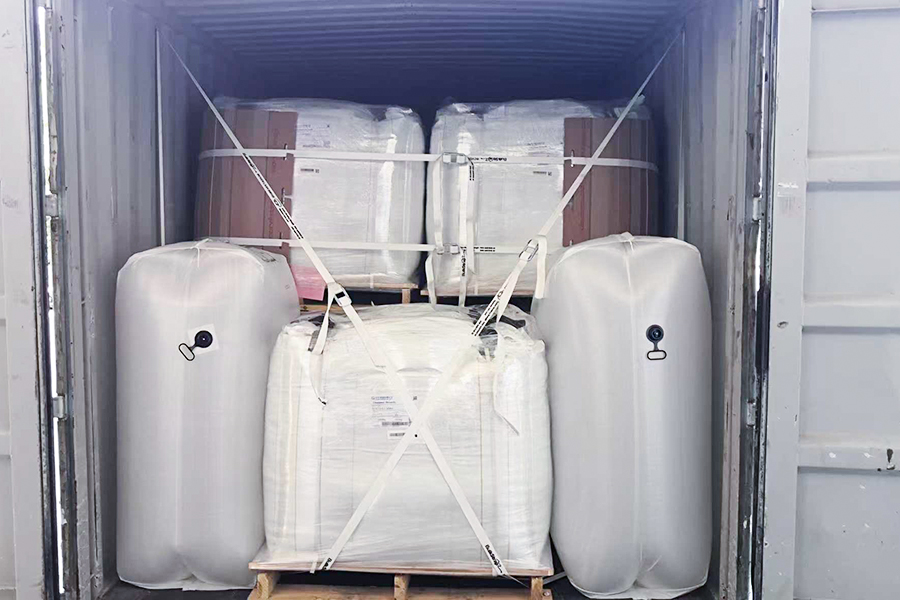
Customer Background: A Southeast Asian new energy equipment manufacturer produces high-value, precision equipment such as photovoltaic modules and energy storage systems, which are shipped globally via sea and land transport. During transportation, the customer needs to ensure the equipment remains stable within containers to prevent damage from bumps and vibrations.
Core Pain Points: The customer found that the gap between the goods and the container walls exceeded 60cm during actual loading, while the standard filling range of conventional air bags is usually within 50cm, which is insufficient to effectively fill and secure the goods. Furthermore, new energy products are heavy, and ordinary air bags, after inflation, tend to shift upwards on single-layer pallets during transport, failing to achieve even stress distribution and still posing a risk of cargo displacement.
Solution: Two Targeted Air Bag Solutions
Based on the customer's usage scenario and cost budget, we provided two professional recommendations:
1. Square Air Bag Solution: Utilizing a square structure design, this solution provides a large and even stress distribution area, avoiding damage caused by excessive localized pressure.
1. **Single Inflation Valve Control:** Simple operation, suitable for transportation scenarios with gaps between 60-80cm.
After inflation, it fits tightly, preventing shifting and providing stable lateral support.
2. **Twin Inflation Bag Solution (Customized High Load-Bearing Solution)** Composed of two independent pads connected together, it can be inflated simultaneously via dual inflation valves, significantly improving inflation efficiency.
It can fill gaps up to 100cm while maintaining uniform expansion, preventing upward movement.
The structure is more robust, with strong load-bearing capacity, suitable for transportation scenarios involving ultra-wide gaps and heavy equipment.
Although the cost is higher than conventional solutions, it is reusable, reducing overall packaging damage and transportation risks in the long run.
Implementation and Feedback: We sent samples of both solutions to the client, along with operation videos and stress explanations. After actual testing, the client reported that the twin inflation bags demonstrated significant stability and filling effect in ultra-wide gaps, fully meeting their export transportation needs for large new energy equipment. Currently, the client has implemented this solution on some high-value routes and plans to gradually expand its use.
Case Value: We didn't stop at "standard product recommendations," but instead delved into our clients' loading and unloading sites to understand the structural limitations and operational pain points in their real-world scenarios. From standard inflatable bags to square ones, and then to customized twin bags, we consistently focused on the fundamental need of "how to secure goods safely and economically," providing progressive, scenario-based packaging solutions.

-
 +86-137 7421 9489
-
 +86-021-67558008
-
 [email protected]
-
 No.769 ,23# building, Fengliang Road,Fengcheng town,Fengxian District,Shanghai,China
Copyright © Shanghai We Pack Co., Ltd. All Rights Reserved.
Cargo Securing Solutions Cargo Transport Protection Solutions

