
 Español



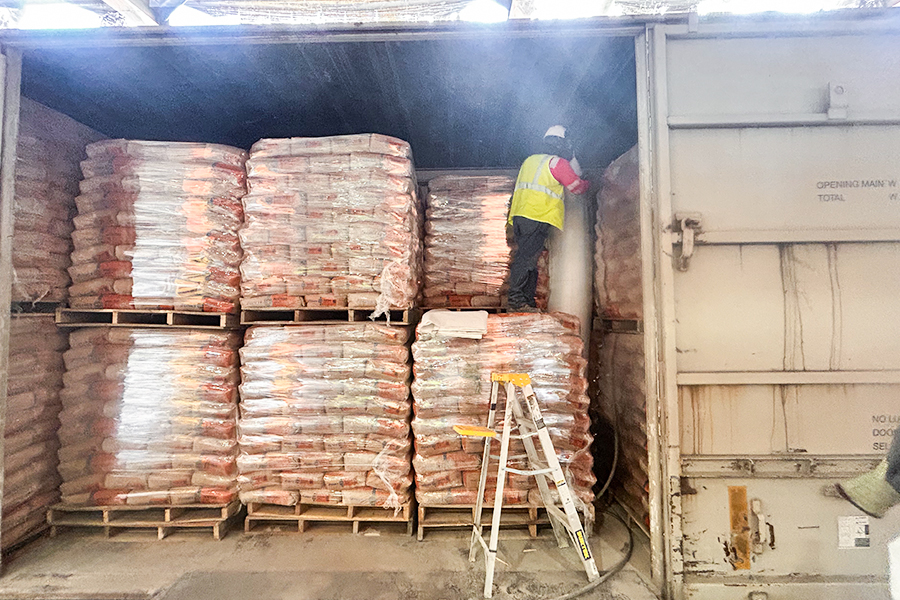
Customer Background: A leading multinational cement production group in North America, which has long transported large quantities of cement products to various North American countries by rail. To improve loading stability, reduce transportation losses, and lower packaging costs, the client is systematically seeking inflatable bag solutions suitable for rail transport.
Core Needs and Challenges:
Compliance Requirements: Products must be certified by the Association of American Railroads (AAR) to ensure compliance with rail transport safety standards, the highest standard certification for inflatable bags globally.
Functional Requirements: Inflatable bags must effectively prevent cement bags from shifting or falling during transport and be reusable at least four times to reduce per-use costs.
Inflatable Bag Structure: Standard inflatable bags are equipped with one inflation valve for inflation and deflation; the maximum size of a standard inflatable bag is 120*240cm; 90% of inflatable bags used in the market are LEVEL 1, which can be reused twice under certain conditions.
Challenges in Adapting to the Scenario: ① In railway transportation, the pressure resistance requirements for inflatable bags far exceed Level 1 performance. ② Train carriage doors can be opened simultaneously for loading and unloading cement, but loading often involves opening only one door. At the unloading site, the customer discovered that it was uncertain whether the opened door would be the one most convenient for operating the air valve to release air. If the opened door was inconvenient for valve operation, workers would have to puncture the inflatable bags before unloading. Punctured bags prevent recycling, contradicting cost reduction goals.
Solution and Collaboration Process: Phase 1: Precise Selection and Strength Upgrade
We systematically introduced our inflatable bag product line, offering five strength levels from Level 0 to Level 4, to the customer. From demand identification, customized samples, trial runs, feedback, product optimization, re-trial runs, further feedback, and further product optimization, to finally securing a mass production order, the entire process took two and a half years. During the process, the customer tested Level 1, Level 2, Level 3, and Level 4 specifications respectively. After two and a half years of repeated testing, Level 4 was ultimately determined to meet the pressure resistance requirements for cement railway transportation and the requirement of four cyclic trials.
Phase Two: Identifying Real Pain Points and Rapid Response
The customer reported that due to the structural limitations of the railway carriages, both sides of the doors could be opened during unloading. Each time unloading, it was impossible to ensure that deflation was performed from the loading side, forcing damage to the inflatable bags and rendering them unusable. We immediately organized a technical team to conduct an on-site assessment and proposed a "dual inflation valve" design: valves were installed on both sides of the inflatable bag, allowing for convenient inflation and deflation operations from either side of the carriage during unloading.
Phase Three: Customized Prototyping and Delivery Verification
We quickly completed the prototyping of the dual inflation valve inflatable bag and sent the sample to the customer for real-world testing. The customized dual-valve solution improves the reusability of inflatable bags and reduces the rate of human-caused damage, ultimately addressing new pain points and reducing overall costs for our clients.
Case Value: This case study not only demonstrates our product capabilities to meet international certification standards and strength grading, but also highlights our service model of rapid customization and innovation based on our clients' actual usage scenarios. By optimizing a standard "single-valve" product into a scenario-based "dual-valve" solution, we truly helped our clients overcome operational bottlenecks related to reusability, enabling them to achieve their core goals of cost reduction and efficiency improvement.
We believe that good packaging solutions go beyond simply meeting standards; they should adapt to every real-world usage scenario.
Whether your transportation methods are by road, rail, or sea, and whether your goods are cement, building materials, or other industrial products, we are willing to work with you to understand on-site problems and provide truly sustainable and recyclable packaging options.

-
 +86-137 7421 9489
-
 +86-021-67558008
-
 [email protected]
-
 No.769 ,23# building, Fengliang Road,Fengcheng town,Fengxian District,Shanghai,China
Copyright © Shanghai We Pack Co., Ltd. All Rights Reserved.
Cargo Securing Solutions Cargo Transport Protection Solutions

